


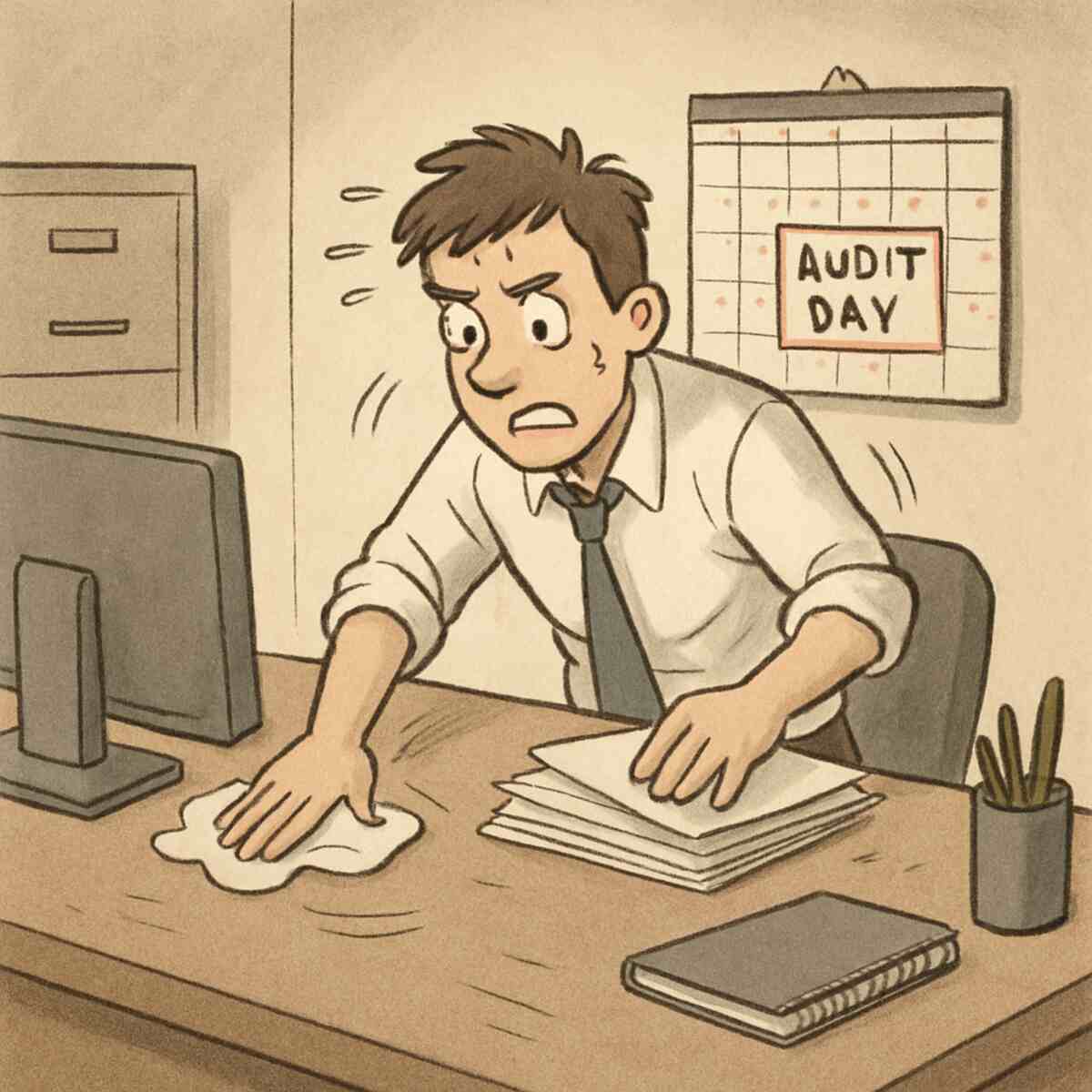
Have you ever scrambled to shove household clutter into a hallway closet just minutes before dinner guests arrive? You haven’t actually cleaned your home; you have merely created a temporary illusion of tidiness for a specific audience. This same universal instinct drives the “audit game” in modern workplaces around the world. Instead of hiding laundry, managers and employees hide inefficient processes or sloppy financial habits just long enough to pass an official inspection. The Amazing fact about slot online resmi.
Financial professionals call this tactic “window dressing,” a strategy in which data or performance is artificially manipulated to appear perfect on a specific day. It creates a perpetual cat-and-mouse struggle between the people doing the work and the people checking it. The core problem behind this game is a deep disconnect between seeming compliant on paper and actually doing good work in practice. Employees often spend immense energy making sure the right boxes are ticked, even if the underlying business remains a chaotic mess behind the scenes.
According to experts in behavioral economics, systems naturally drift toward this surface-level behavior because of how organizations measure success. When workers are judged entirely by a rigid metric, they will naturally optimize for that number at the expense of everything else. This shift creates “symbolic compliance,” which means playing along with the rules just enough to avoid trouble, rather than achieving “substantive compliance,” where the actual quality of work improves. It is the corporate equivalent of eating a salad in front of your doctor while keeping a box of donuts hidden in your car.
Consider a customer service department that suddenly requires representatives to keep every phone call under three minutes. To hit this new target, agents might simply hang up on callers who have complicated problems. On paper, the department looks incredibly efficient to an outside auditor, but in reality, customer satisfaction is plummeting. The measurement itself has become the primary target, completely replacing the actual goal of helping people solve their issues.
Learning to recognize this psychological “cleaning house” effect in yourself and others is a surprisingly valuable career asset. By understanding how game theory drives people to prioritize looking good over being good, you can see past the window dressing, turning the daily audit game from a bureaucratic frustration into a powerful framework for sharpening your own financial and analytical skills.
The ‘I Know Something You Don’t’ Advantage: Understanding Information Asymmetry
Watching a teenager clean their room by shoving everything under the bed just before their parents walk in is a perfect example of “information asymmetry.” This simply means one person knows something the other doesn’t. In the audit game, this knowledge gap is the ultimate advantage. The worker knows exactly where the mess is hidden, while the inspector only sees a spotless floor. This uneven playing field is exactly what makes the strategic behavior of auditees possible.
To fix this imbalance, managers often demand mountains of paperwork, assuming more data will automatically reveal the truth. Sadly, this ignores three distinct blind spots in any oversight system: inspectors aren’t present constantly, they rarely observe the actual work process, and they lack the daily context to understand the numbers. Because the worker controls what goes into the final report, demanding more tracking simply creates more chances to massage the figures. You aren’t seeing the reality of the work; you are looking at a highly curated presentation designed strictly to pass the test.
Spotting this illusion means looking past perfect spreadsheets to ask what details are conveniently missing. Whenever performance magically skyrockets right before a scheduled review, you are witnessing the exact moment genuine effort transforms into clever manipulation. People naturally hide flaws to secure rewards, especially when their livelihood depends on passing an inspection. Recognizing this survival instinct is crucial when simple progress metrics mutate into the only goals that matter.
When a Metric Becomes a Target: How Goodhart’s Law Destroys Real Value
Being evaluated entirely on how many emails you send would likely lead you to send pointless one-word messages just to hit your quota. This perfectly illustrates Goodhart’s Law: when a measure becomes a target, it stops being a good measure. In the audit game, people quickly realize managers only care about the specific number being tracked. Instead of substantive performance, focus shifts to a “vanity metric”—a number that looks fantastic on a spreadsheet but offers zero real value.
Confusing shiny numbers with real success creates perverse incentives, which accidentally reward the exact opposite of your intended goal. You can spot this destructive pattern everywhere:
- Call centers: Agents judged strictly on “average call time” will hang up on difficult customers to keep their daily stats low.
- Schools: Teachers evaluated by standardized test scores spend months “teaching to the test,” completely ignoring broader critical thinking skills.
- British Railways: Historically, managers judged trains solely by punctuality, so delayed trains would skip scheduled stops to catch up, leaving waiting passengers stranded.
Protecting your organization requires auditing your targets to ensure they aren’t secretly encouraging bad behavior. If a goal can be achieved without doing meaningful work, it is a vanity metric, not a true leading indicator of success. You must re-align your goals to focus on substantive performance rather than just checking boxes. Recognizing how these well-intentioned metrics fail explains why we often create “cobras” when trying to solve problems.
Why We Create ‘Cobras’ When We Try to Solve Problems
Implementing a quick fix at work only to watch it spectacularly backfire is a frustrating experience known as the Cobra Effect. During British rule in India, the government sought to reduce the venomous cobra population by offering a cash reward for each dead snake. Initially, it worked beautifully. However, enterprising citizens soon began breeding cobras simply to collect the bounty. When the government realized the scam and canceled the reward, breeders released their worthless snakes, leaving the city with a worse problem than before.
Modern workplaces suffer from these same perverse incentives, turning simple oversight into an exhausting audit game. If you penalize workers for reporting safety incidents, they won’t work safer; they will just hide the injuries. To prevent this, managers must evaluate how their current incentive structures might secretly encourage rule-breaking. By embracing the benefits of behavioral economics in internal controls, leaders can anticipate how human nature will exploit a new metric before it ever goes live.
Ultimately, predicting these unintended consequences requires viewing your policies through the eyes of someone trying to beat the system. Instead of writing stricter rules, you must understand the underlying tug-of-war between the rule-makers and the rule-followers. Recognizing this constant adaptation pushes us past simple psychology and into a more formal battle of wits: calculating the Nash equilibrium in auditing.
The Strategic Standoff: Calculating the Nash Equilibrium in Auditing
Every day, employees and inspectors face an invisible game of chicken. When someone cuts corners, they aren’t necessarily malicious; they are usually just weighing their options. This standoff is best understood by modeling auditor and auditee payoff matrices—a simple scoreboard comparing the rewards of true compliance against the consequences of getting caught faking it. If hiding budget flaws earns a massive bonus but only yields a minor warning when discovered, cheating becomes the most logical choice.
To find exactly where a system breaks down, you must understand how to calculate nash equilibrium in auditing. This mathematical concept describes a “balance point” where neither the worker nor the inspector wants to change their strategy because they are already getting the best possible deal. You can map out this logical standoff in three steps:
- Identify the reward: What is the specific benefit of faking the work, such as leaving early or hitting a quota?
- Weigh the penalty: How severe is the punishment, and what are the actual odds that the auditor will find the hidden mess?
- Find the balance: If the daily reward for cheating outshines the rare risk of getting caught, deception naturally becomes the default strategy.
Using this logic, leaders can quickly determine if a penalty genuinely deters bad behavior. If the punishment doesn’t outweigh the payoff, moral lecturing won’t fix the process. Workers will simply play the odds as long as they are favorable. This dynamic deteriorates further when employees identify oversight patterns and predict the inspector’s schedule.
Why Predicting the Inspector’s Schedule Leads to Systemic Failure
Drivers instinctively brake for familiar speed traps, only to hit the gas again once the police car disappears. This illustrates “Systematic Bias,” a blind spot created when oversight follows a predictable routine. If a restaurant manager knows the health inspector always visits on the first Tuesday of the month, the kitchen is spotless on Monday and a mess by Friday. The audit simply measures the staff’s ability to read a calendar, not their actual daily hygiene habits.
Fixing this loophole requires applying “Deterrence Theory,” the idea that a constant, lingering threat of being caught drives better behavior than a massive but predictable punishment. When evaluating randomized vs systematic inspection strategies, unpredictability is the ultimate psychological weapon. If people believe an auditor could appear at any moment, they are forced to maintain consistent quality standards rather than cramming for a scheduled exam.
Small schedule disruptions can radically alter behavior, reducing a system’s gameability by roughly 50 percent without requiring extra money or manpower. You can implement “mini-random” checks in your own business or personal finances by reviewing random expense categories on unexpected afternoons rather than doing a highly anticipated month-end sweep. Ultimately, the optimal frequency for regulatory compliance checks isn’t about auditing more often; it is about auditing when people least expect it.
Stripping away predictability ensures that the pristine results you see on paper actually reflect everyday reality. Once you break the rhythmic cycle of the audit game, the challenge shifts to finding where the cleverest rule-breakers hide their tracks using probability models.
How to Use Probability Models to Catch Corporate Fraud
When people try to fake a spreadsheet, their biggest enemy isn’t the auditor—it is their own brain. Humans are terrible at generating truly random numbers, often spreading them out far too evenly because we mistakenly think that is what “random” looks like. In the high-stakes world of detecting corporate fraud using probability models, investigators actively hunt for these psychological blind spots. If a department’s financial reports look perfectly balanced or “too good to be true,” it is usually a giant red flag that someone is manually massaging the data to pass an inspection.
A fascinating mathematical quirk called Benford’s Law acts as the ultimate lie detector against this kind of manipulation. This rule dictates that in naturally occurring datasets—like tax returns, street addresses, or genuine company expenses—about 30 percent of all numbers will naturally begin with the digit “1,” while only about 5 percent start with a “9.” Cheaters usually don’t know this rule, so when they invent fake invoices, they guess wildly, starting amounts with 5s, 6s, and 7s to make them look naturally scattered.
Spotting these unnatural patterns doesn’t require a math degree; you can actually apply this logic to your everyday expense tracking just by scanning the first digits of your receipts. Auditors now run simulation tools for organizational transparency to instantly highlight datasets that violate Benford’s predictable curve. Once the math flags an artificial pattern, investigators know exactly where to focus their deep dive. These probability concepts expose actual systemic flaws, as demonstrated by the real-world lessons from the PA Game Commission audit.
The Real-World Lessons from the PA Game Commission Audit
Finding fake numbers on a spreadsheet is only half the battle; the other half is figuring out what people are doing with the very real money they hide. When investigators dug into the finances of Pennsylvania’s wildlife management, the resulting PA Game Commission audit revealed a classic example of “gaming” a budget. Instead of outright stealing, organizations sometimes play a different game: hoarding. They quietly shuffle millions of dollars into restricted accounts or hidden buckets, creating an artificial sense of financial scarcity to justify asking for more public funding.
This behavior highlights exactly why public sector transparency matters to anyone trying to manage an organization’s money. The commission’s actions offer several critical takeaways for identifying “slush funds” and improving how you allocate resources:
- Follow the inactive money: Just because funds are labeled “committed” doesn’t mean they are actually being spent on immediate quality assurance or active projects.
- Question the scarcity: If a department constantly claims they are broke, verify its reserve accounts before approving new budgets.
- Demand clear timelines: Hidden buckets thrive when there is no strict deadline tied to a project’s funding.
You don’t need to run a state agency to apply these public sector lessons to your own business. By looking for these same hoarding patterns, you can build an effective risk assessment in governance frameworks that keeps your team honest about what resources they genuinely need. However, simply catching these budget games and punishing the players often creates an entirely new set of problems regarding high compliance.
Why High Penalties Don’t Always Equal High Compliance
When a system breaks, the instinct is often to drop the hammer and increase the punishment. But just as in a Nash Equilibrium—where players continually adjust strategies in response to others’ moves—auditors quickly discover the elasticity of compliance. This concept explains how human behavior stretches or snaps depending on the applied pressure. If failing an audit means losing their livelihood, employees will pour all their energy into building elaborate cover-ups rather than doing the actual work. Tracking the impact of penalty levels on compliance rates reveals a distinct “sweet spot” where fines deter bad behavior without triggering a desperate need to cheat the system entirely.
In a busy restaurant kitchen where dropping a plate results in immediate termination rather than a simple warning, broken glass gets quietly kicked under the fridge. When leaders ask how incentive structures affect audit accuracy, the answer usually lies in this exact fear response. Massive penalties create an environment of extreme self-preservation, destroying the psychological safety needed to build a culture in which small mistakes are reported rather than hidden.
Genuine transparency requires organizations to balance “The Stick” with “The Carrot” for long-term accuracy. When people receive proportional, fair corrections for errors instead of draconian punishments, the data stays clean. Yet, even with perfect incentives, managers cannot check every single daily transaction. Since massive threats alone won’t secure the truth, you must outsmart the players by mastering strategic sampling to find the needle in the financial haystack.
Mastering Strategic Sampling: How to Find the Needle in the Financial Haystack
Checking every single receipt in a business is mathematically impossible, which is why smart oversight relies on targeted strikes rather than exhaustive searches. When auditors face mountains of data, they use strategic sampling to decide exactly where to shine their flashlights. This process involves predicting human behavior and focusing purely on areas where the temptation to bend the rules is highest.
When inspecting a massive apple orchard for disease, knowing trees near the river are more prone to mold dictates testing more apples from that specific area. In business, this technique is called “stratified sampling”—dividing data into risk categories and conducting more extensive testing on the most suspicious groups. Companies using this strategy routinely reduce audit time by 30% by focusing on high-risk categories, such as unusual late-night refunds, rather than on everyday office expenses.
The true power of this approach lies in its ability to deter intentional manipulation when applied to your own internal quality control. A genuinely effective risk assessment identifies the hidden pressure points in your workflow, prioritizing the specific operations where cover-ups cost you the most. Consequently, minimizing tax evasion through strategic sampling techniques becomes highly practical, as wrongdoers realize their most vulnerable, high-dollar transactions are constantly in your crosshairs.
Better oversight ultimately comes down to outsmarting the system rather than just working harder to check every single box. Once you stop verifying the obvious and start hunting for anomalies in the shadows, you are ready to study the deeper psychology of compliance through an adversarial approach.
The ‘Professional Game Academy’ Approach to Mastering Oversight
Just as police sometimes hire an ex-thief to catch a bank robber, modern oversight relies on learning from the rule-breakers. Instead of just teaching accountants to read spreadsheets, a modern professional game academy audit company trains its staff to think like hackers. This requires stepping out of the traditional rule-follower role and actively imagining the easiest ways to cheat the system. By learning how the game is played from the inside, investigators can easily spot the invisible tricks people use to hide their mistakes.
Adopting this “adversarial mindset” is a highly effective way to pressure-test your own workplace. Think of it as checking your home’s security from a burglar’s perspective rather than a homeowner’s. If you want to know if an expense policy actually works, stop reading the rulebook and ask, “If I needed to bypass this rule today, how would I do it?” Finding those structural weaknesses yourself removes the dangerous blind spots where fake, symbolic compliance usually hides.
To put this proactive mindset into practice, teams frequently rely on simulation tools for organizational transparency. These mock drills let managers safely test how systems hold up when targets become impossibly high or budgets shrink. Uncovering the true motivations behind why people bend the rules naturally highlights behavioral economics as the secret to internal controls.
Why Behavioral Economics is the Secret to Internal Controls
Most companies try forcing honesty with thick rulebooks, but human nature naturally resists rigid checklists. The real secret to compliance lies in shaping how choices are presented—a concept behavioral economists call “choice architecture.” If you want to realize the benefits of behavioral economics in internal controls, you must stop simply threatening people with audits and start making the right choice the path of least resistance.
Rather than changing the rules, you can change the environment using a “nudge”—a subtle psychological push that guides behavior without restricting freedom. By aligning these nudges with natural incentive structures, you dramatically improve team honesty without adding frustrating bureaucracy. Here are four simple nudges you can build into daily operations:
- Sign first: Ask employees to sign an honesty declaration at the top of a form rather than the bottom, priming them to tell the truth before they fill in the numbers.
- Set smart defaults: Make the compliant, secure choice the automatic default in your company software.
- Use social proof: Highlight positive peer behavior on dashboards, like noting that “90% of your department files accurate expenses on time.”
- Require explanations: Ask for a brief, written sentence for unusual requests rather than a simple checkbox, adding just enough friction to deter careless behavior.
When you design systems that make the right thing the easiest thing, you remove the motivation to play the audit game entirely. People naturally follow the path of least friction, allowing you to use gentle psychology instead of exhausting, constant reviews. Over-monitoring can actually backfire, leading to the surprising reality that frequency checks can lower your standards.
How Frequency Checks Can Actually Lower Your Standards
Living with a smoke detector that triggers every time you boil water eventually leads you to just remove the battery. This same phenomenon occurs at work when managers obsessively monitor teams, leading to “audit fatigue.” When subjected to constant micro-reviews, employees naturally tune out the process’s actual purpose. Instead of fostering excellence, hyper-frequent monitoring drains energy and creates an environment where people just want the inspector to leave.
This exhaustion quickly breeds “compliance theater”—a situation where teams spend more time acting compliant than actually doing good work. If a restaurant manager checks the kitchen logs every hour, the staff will stop focusing on cooking just to fill out the paperwork. To prevent this performative busywork, organizations must determine the optimal frequency for regulatory compliance checks in their specific field. Finding this sweet spot ensures that audits remain meaningful events rather than daily annoyances that incentivize employees to fake their reports just to save time.
Stepping back from the magnifying glass shifts your focus toward improving resource allocation for quality assurance. By investing in deeper, less frequent evaluations, you build systems in which honest mistakes are caught without treating every employee as a suspect. However, even with perfectly balanced monitoring, human beings will still weigh the risks and rewards to model the payoff and decide when it is worth cheating.
Modeling the Payoff: When Is It Worth It to ‘Cheat’?
Deciding whether to pay a $10 parking meter or risk a $20 ticket is a classic risk calculation. If the inspector only checks one in ten cars, the “expected value” of the penalty is mathematically just $2. Because the math heavily favors skipping the meter, cheating becomes the rational choice. This simple calculation drives the strategic behavior of auditees in almost any setting. When the effort or financial cost of doing things right exceeds the statistical risk of getting caught, the system naturally encourages people to cut corners.
Fixing this dynamic requires analyzing the situation as a calculated exchange. By modeling auditor and auditee payoff matrices, you map out the exact rewards for hiding the truth against the consequences of discovery. If an employee earns a massive bonus for hitting impossible targets but faces zero real punishment for faking data, the matrix is rigged. Spotting these broken incentives helps you understand why otherwise honest workers manipulate metrics under pressure.
Shifting the workplace balance toward integrity means changing those underlying numbers. Leaders must either lower the daily burden of compliance or increase the certainty of being caught. Once you understand how to design environments where honesty is genuinely the most profitable path, you can apply these same decision-making principles using game theory to improve your personal budgeting.
Using Game Theory to Improve Your Personal Budgeting
Applying those exact payoff matrices to your own wallet reveals a surprising truth: the person you are most likely to cheat is yourself. When tracking monthly expenses, you might deliberately leave out a spontaneous dinner from your spreadsheet because seeing the negative balance feels terrible. This is “self-gaming,” where you manipulate your personal data to pass your own internal review. Instead of actually spending less, you just make the math look better on paper, playing the audit game at the expense of your own savings goals.
The root of this financial self-deception lies in a psychological trap known as cognitive dissonance. Whenever your actions—like buying an expensive jacket—clash with your identity as a frugal saver, your brain experiences intense mental friction. To relieve that discomfort without returning the item, you simply redefine the purchase as a “work necessity.” By translating game-theory applications in financial oversight into your everyday life, you can easily spot these mental gymnastics. You are acting as both the strict accountant and the sneaky employee, finding loopholes in your own rules to avoid feeling guilty.
Stopping this cycle requires building a bulletproof personal expense tracker that removes in-the-moment judgment calls. If you decide in advance exactly what counts as a “want” versus a “need,” you close the loopholes before you can exploit them. Treat your budget like an unbending external inspector rather than a flexible suggestion. Once you establish boundaries that you cannot easily manipulate, you realize why the mere presence of a strict rule changes your behavior, proving the threat of an audit matters more than the audit itself.
The Deterrent Effect: Why the Threat of an Audit Matters More Than the Audit Itself
A parked police car, even if completely empty, instinctively causes drivers to hit the brakes. In the workplace, this phenomenon is known as “general deterrence.” It proves that catching every mistake isn’t necessary if the psychological weight of maybe getting caught is strong enough. By using unpredictable ‘spot checks’ as a psychological tool for quality, leaders naturally influence daily habits. When comparing deterrent effects of different audit frequencies, knowing a check could happen today drives far better continuous performance than a guaranteed review next month. A perfectly scheduled review simply invites people to play the audit game by cramming their compliance at the last minute.
To maximize the ‘perceived risk’ of non-compliance without actually increasing your management workload, you must understand how people mentally calculate their chances of getting caught. You can easily elevate this perceived risk by adjusting three specific factors:
- Visibility: Employees must see that oversight actually happens to others, proving the threat is real.
- Randomness: Unpredictable timing removes the ability to hide messes just for the inspector.
- Severity: The consequence of failing a spot check must outweigh the brief convenience of cutting corners.
When these elements align, the sheer possibility of an inspection transforms behavior across an entire organization. Instead of hiding shortcuts, teams focus on maintaining genuine quality, laying the perfect foundation for ‘anti-game’ frameworks.
Creating ‘Anti-Game’ Frameworks for Small Businesses
Building a culture where people naturally want to do the right thing requires much more than surprise inspections. Employees often view workplace rules as bureaucratic hurdles, prompting them to merely pass the test rather than do the work well. Leaders must instead create “Anti-Game” designs where the easiest way to pass an audit is to actually do a great job. This begins by establishing an effective risk assessment in governance frameworks for startups, making oversight a helpful operational guardrail rather than a trap.
Because any measure quickly becomes a meaningless target when tied directly to rewards, smart managers must design ‘Anti-Game’ metrics that align with real business growth. A support team evaluated strictly on call speed will inevitably hang up on complex problems just to keep their numbers looking good. An anti-game approach fixes this by measuring the substantive goal—like overall customer satisfaction—rather than easily manipulated proxies like call duration.
Shifting this mindset means moving from ‘Symbolic’ to ‘Substantive’ compliance in three straightforward phases. First, management strips away vanity metrics that add no daily value to the workflow. Next, they involve the employees doing the actual work in creating new, practical success markers. Finally, leaders reward transparency about mistakes rather than punishing honesty, naturally encouraging teams to prioritize genuine excellence over simply ticking boxes.
Anticipating the strategic behavior of auditees allows you to stop playing cat-and-mouse. When oversight genuinely helps people excel, the incentive to cheat vanishes. This organic shift toward continuous improvement demonstrates why quality assurance remains the best defense against fraud.
Why Quality Assurance is the Best Defense Against Fraud
Major corporate scandals often start as small, overlooked administrative errors. While a traditional audit acts like a sudden health inspection, Quality Assurance (QA) is your daily routine, checking for honest mistakes. Bridging the gap between daily operations and high-level oversight allows QA to monitor process integrity, ensuring actual work matches expected standards. When daily systems easily catch simple errors, hiding intentional theft becomes nearly impossible.
Smart organizations recognize that stopping financial leaks requires improving resource allocation for quality assurance where it matters most. Instead of randomly double-checking every receipt, managers analyze routine error patterns to find weak spots. Think of it as a weather forecast for bad behavior; detecting corporate fraud using probability models helps leaders predict exactly where employees might game the system next. If a department suddenly spikes in “lost” paperwork, everyday QA data becomes an early warning siren.
Shifting focus from punishing failure to building reliable habits creates a workplace where cheating simply takes too much effort. Because routine checks remove the shadows where bad actors hide, everyday quality control is your best defense against malicious behavior. As businesses grow tired of playing this exhausting cat-and-mouse game manually, they naturally seek automated, continuous validation and real-time oversight through AI.
The Future of the Audit Game: AI and Real-Time Oversight
Knowing the exact timing of a regulatory inspection allows businesses to artificially clean up just in time. For decades, the traditional audit game relied on this exact strategy, where businesses used strategic sampling to guess when and where inspectors would look. However, the days of cramming for the annual financial review are rapidly coming to an end. Instead of relying on random spot-checks, modern organizations are adopting continuous auditing, a process that evaluates data the exact moment it is created.
This shift from periodic reviews to real-time oversight completely rewrites the rules of workplace compliance. Artificial intelligence acts like a sophisticated security system for company records, making the classic “window dressing” strategy nearly impossible to pull off. You can no longer hide a messy kitchen just before the health inspector arrives if they are watching a live feed of your prep station all year. AI-driven fraud detection scans every single transaction as it happens, easily flagging split-second decisions in which an employee might try to manipulate their performance metrics.
To stay ahead of these everyday manipulations, software developers are creating advanced simulation tools for organizational transparency. These programs do more than just crunch numbers; they learn the normal, healthy rhythm of a company’s daily operations. If an overstressed sales team suddenly starts logging impossible call times right before a deadline, the algorithm immediately notices the unnatural pattern. By comparing actual behavior against a simulated baseline of honest work, these systems highlight the exact moments when people stop doing real work and start playing the system.
Surviving in this transparent environment means letting go of the instinct to temporarily manipulate numbers for a passing grade. Because algorithms now monitor the continuous reality of your work rather than a staged snapshot, trying to trick the system will only flag you faster. Navigating this shift requires a completely different mindset to transform from a ‘gamer’ to a master of oversight.
Action Plan: Transforming from a ‘Gamer’ to a ‘Master of Oversight’
You now see the audit game clearly: a predictable dance driven by Goodhart’s Law, information asymmetry, and the Nash Equilibrium. The ultimate goal isn’t simply passing tests; it’s building systems that never need to be gamed in the first place.
Apply game theory to your daily financial decisions to spot and stop symbolic compliance. This new awareness drives effective risk assessment, helping you focus on substantive reality rather than polished, bureaucratic illusions.
You now possess the strategic behavior analysis skills required to anticipate how people manipulate targets before the cheating even begins. Protect your organizational health today using this checklist for auditing your own audit processes:
- Define the actual goal, not just the metric.
- Ensure your targets don’t create perverse incentives.
- Look for the hidden messes behind suspiciously perfect numbers.
- Track the time wasted solely on preparing for checks.
- Reward honesty and transparency over flawless, manipulated scores.
Transparent communication empowers teams to stop playing the game. When you champion truth over perfect metrics, genuine progress finally replaces empty compliance.
